Do You Have Little Tan Golf Balls On Your Oak Tree?
Every fall in Central Texas somebody walks out to the live oak in their yard and finds the branches covered with what look like little tan golf balls. Some years there are only a dozen and some years there are thousands. The balls eventually fall off on their own. And if you’ve ever stepped on one, or cut one in half, you’ve seen the hard little chamber at the center contains a little grub.
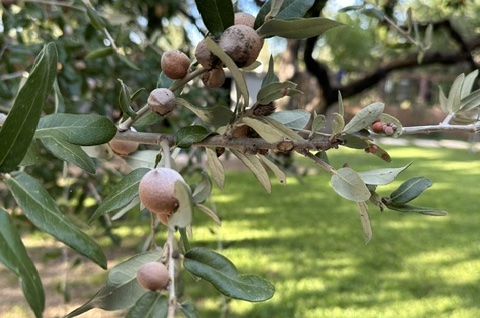
A lot of people assume they’re looking at some kind of malformed acorn, one that never grew a cap, or grew wrong somehow. Maybe the tree itself has a problem making its own fruit. It’s a fair guess, they’re roughly acorn sized and hang in the same spots acorns do, but that’s not what they are. Or – especially once they’ve seen the little bug inside the ball – they think that their tree might be under attack by some kind of invasive species. That’s usually when they pick up the phone and call our arborists.
What Are The Little Balls On My Oak Tree?
The little balls are called galls. The tree grows them by itself, like it grows branches and leaves and acorns. But the tree grows a gall because of something an insect does. The round balls on Texas oak trees are caused by a cynipid wasp. On Central Texas live oaks the usual suspect is Disholcaspis cinerosa, the mealy oak gall wasp. It’s one of the most common galls on live oaks in Texas.
Are They Oak Apples?
Probably not. You’ll hear people call them oak apples, and there is a genuine oak apple gall, but it’s caused by a different group of wasps. There are hundreds of other gall wasps working other oaks in other ways. But if you’re standing under a live oak around Austin holding a tan or light brown sphere somewhere between the size of a marble and a small plum, it’s almost certainly a mealy oak gall.
Do Mealy Oak Gall Wasps Make The Galls?
The wasp doesn’t actually build the little structure. She just lays an egg in a tree branch, and the tree responds by growing a structure around it. The gall grows for a while and then stops, and the larva sits in that central chamber and spends the winter there. The grub is one future wasp, not a batch of eggs. One larva equals one gall equals one wasp.

The life cycle is genuinely odd. The adult that emerges from a round gall is a female that reproduces without mating at all. She lays eggs that produce a second, entirely different generation. The new generation makes a completely different kind of gall, a small beige thing on the buds that most people don’t even notice. That generation has both males and females, they mate, and the round balls start over. Two generations a year, two unrelated-looking homes, but the same wasp.

Are Mealy Oak Gall Wasps Dangerous?
No they are not dangerous. When people learn the little balls on their oak tree have future wasps inside, they have obvious and reasonable safety concerns. It’s easy to imagine thousands of wasps hatching at once in your back yard, attacking your kids and pets. But mealy oak gall wasps are not dangerous. The adult is only about a quarter inch long, doesn’t have any real sting to speak of, and spends almost its entire life either inside a gall or briefly flying to lay the next round of eggs. Nobody is getting stung by one of these in their yard.
Other Common Central Texas Insect Galls
Live oaks get the most attention because the round balls are so visible. But they’re far from the only tree in Central Texas dealing with galls. Hackberries almost always carry small nipple-shaped galls across their leaves, caused by a tiny insect called a psyllid rather than a wasp. Pecans have their own version from phylloxera, a relative of the aphid, usually showing up as swollen blister-like bumps on the leaves in spring. Elms and cottonwoods have their own gall makers too. Oaks as a group host several hundred different kinds between them, so even a Spanish or red oak with no round balls on it isn’t necessarily gall-free. It’s just hosting a different insect making a less obvious mess.
Do Galls Hurt My Oak Tree?
Nope.
That sounds dismissive, and I know a tree can go from clean to covered in galls in one season and it looks alarming, but the galls are cosmetic. Trees carry heavy loads of them year after year with little to no harm, and the numbers swing wildly on the same tree from one season to the next. Susceptibility isn’t even evenly spread. Only about one live oak in sixteen turns out to be really prone, and an unlucky tree can produce ten thousand galls while the one next door produces none. The wasp is also picky, and only works on live oaks, so your Spanish or red oaks aren’t next.
If a live oak itself looks unhealthy and also has galls, the galls are almost never the problem. A stressed oak in this part of the country is usually dealing with drought, or compacted soil, or roots buried under too much fill. Those are all problems we can help you solve.
Please Don’t Use Pesticides On Galls
There’s no effective chemical control for these once the gall has already formed. The larva is sealed inside a tough woody gall. Nothing sprayed on the outside of the tree is going to reach it. What a broad spray will do is kill the helpful things – the butterflies and bees we want and need, as well as the parasitic wasps that actually attack the galls and that’s real natural control. You can spot the parasitized galls by size, roughly an eighth to a half inch, while the ones that made it through run a half inch to an inch.
There is one chemical treatment that many arborists offer, a systemic insecticide injected into the trunk or applied to the soil before the wasps lay their eggs in spring, meant to make next year’s galls less likely. We do offer this treatment. But the research on it – including university studies specific to this wasp – are mixed at best. Since the galls don’t hurt the tree and the wasp isn’t any kind of threat to people, it’s not something we’d say is generally necessary. If someone’s determined to do something about it anyway, it’s an option, just one with results that can be inconsistent.
Galls Help The Ecosystem
And there’s more going on inside the galls too. A developing gall secretes a sugary substance that draws in flies, butterflies, honeybees, and predatory wasps, all of them feeding until it dries up in late fall. Once the wasp leaves, the empty gall gets taken over by scavenger ants, small spiders, lacewing larvae, other little predators. The old ones hang on the limbs for years, full of their new tenants.
So the little woody ball hanging on your live oak is a food source, a shelter, a nursery, and eventually an apartment. It’s a whole small economy that people are trying to poison because they think the tree looks untidy.
Do You Still Have Live Oak Questions?
Are you concerned about your central Texas live oak tree? Contact a certified arborist, so you don’t have to guess what the problem is. We’re happy to come out. Give us a call!
Free On-Site Estimates
7am – 7pm
7 days a week